Spend stratification: grouping parts into kitties
Split spend by product line, group parts into commodity kitties, should-cost each kitty and negotiate one supplier and one kitty at a time.

Key takeaways
- Stratify first: products, then commodity kitties, then parts.
- Should-cost the kitty, not random parts, so each negotiation covers a coherent group.
- One supplier, one kitty, one discussion keeps negotiations focused.
- Track the gap per part and roll it up per kitty to prioritise.
A running-parts portfolio can contain thousands of parts and dozens of suppliers. Trying to cost it all at once fails. Stratifying it first makes it manageable.
Four steps
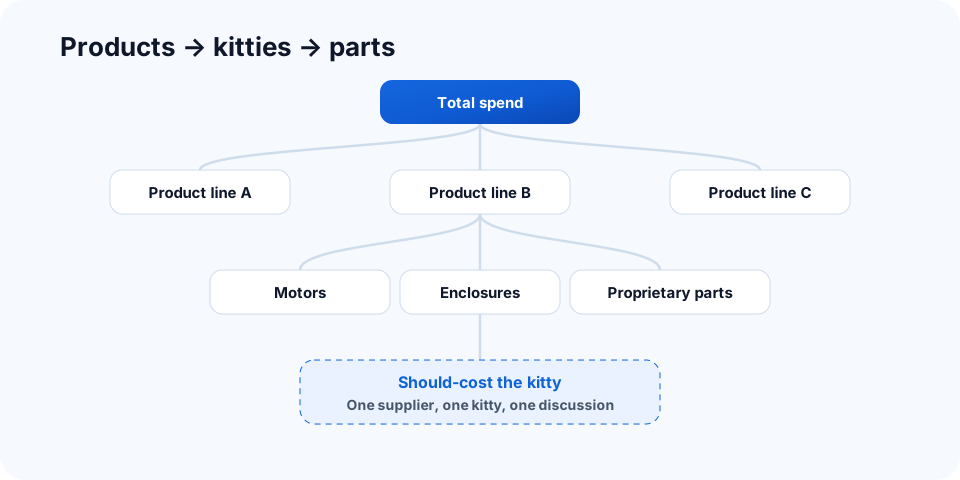
Illustrative stratification: products, then kitties, then parts.
- Split spend by product line. For an appliance maker, for example: refrigerators, washing machines, air conditioners.
- Group parts into kitties. Within each line, group by commodity or process: motors, drum assemblies, enclosures, proprietary parts.
- Should-cost each kitty. Cost the parts in the kitty, starting with the highest spend, to get a should-cost per part and a quote gap per supplier.
- Negotiate kitty by kitty. One supplier, one kitty, one discussion, with levers per part.
Why kitties work
Parts in a kitty share a process and often a supplier base, so the same rates, machine assumptions and arguments apply across them. A negotiation about a kitty is coherent: the supplier’s engineers can discuss it as one family.

Fasteners make a natural kitty: similar process, similar suppliers, one cost model. Photo: Edge2Edge Media, Unsplash.
Prioritising
Roll the gap per part up to the kitty. Kitties with large total gaps and strong evidence go first. Proprietary parts form their own kitty and follow their own method.

Rank the kitties by spend and by the gap between quote and should-cost. Photo: Myriam Jessier, Unsplash.
A checklist for your first kitty
- Pick one product line where spend is high and the part list is stable.
- Export the part list with annual spend and supplier for that line.
- Group by commodity or process until each group has one obvious “family” (enclosures, turned parts, harnesses, proprietary parts).
- Rank the kitties by spend and choose one where you have drawings or models for most parts.
- Collect inputs for the top parts: drawing, STEP model, current price and, if available, the supplier’s cost breakup.
- Should-cost the top parts first. The rates and assumptions you settle on carry over to the rest of the kitty.
- Compute the gap per part and roll it up to see what the kitty is worth.
- Prepare levers per part and meet one supplier about one kitty.
- Record what was agreed, per line, so the next review starts from evidence.
Common pitfalls
- Kitties that are too broad. “Metal parts” mixes processes and suppliers; split until each group shares a process.
- Starting with the hardest kitty. Early wins build the method and the credibility; start where the data is good.
- Mixing proprietary parts in. They need their own approach and slow everything else down.
Related reading
For the sole-source kitty, see costing proprietary parts. For the negotiation itself, see negotiating with a cost breakdown, or the existing part cost reduction service.
Frequently asked questions
What is a kitty?
A group of parts that share a commodity or process, for example sheet-metal enclosures or motors, so they can be costed and negotiated together.
Do we need to should-cost every part?
No. Within each kitty, start with the highest-spend parts and those with the largest suspected gaps; the method and rates then carry over to the rest.
Where do proprietary parts go?
Into their own kitty. They need a different approach (supplier data or teardown, plus a market benchmark) and are best handled separately.
Keep reading
Procurement 3 min read Costing proprietary and sole-source parts
With no second quote, a should-cost is your only independent reference. Two routes to it, supplier data or teardown, plus a market benchmark.Read the articleNegotiation 3 min read Negotiating with a supplier using a cost breakdown
Compare the supplier's quote with a should-cost line by line, find where the gap sits, and turn each difference into a question the supplier can answer.Read the articleCosting 4 min read What is should-costing? A guide for procurement teams
Should-costing estimates what a part ought to cost from first principles. How it works, what it needs, and how buyers use it in negotiation.Read the article