Costing proprietary and sole-source parts
With no second quote, a should-cost is your only independent reference. Two routes to it, supplier data or teardown, plus a market benchmark.
Key takeaways
- No second quote does not mean no reference: a should-cost is one.
- Route A: obtain the data from the supplier. Route B: teardown and reverse engineering.
- A market benchmark adds what competitors buy and pay to the engineering view.
- Use the result for levers, not ultimatums; the supplier relationship still matters.
Sole-source parts are where buyers often feel weakest: there is no competing quote, and the supplier knows it. A should-cost changes that, because it does not need a competitor.
Two routes to a model
Every should-cost starts from the part’s geometry, so the first question is how to get it.
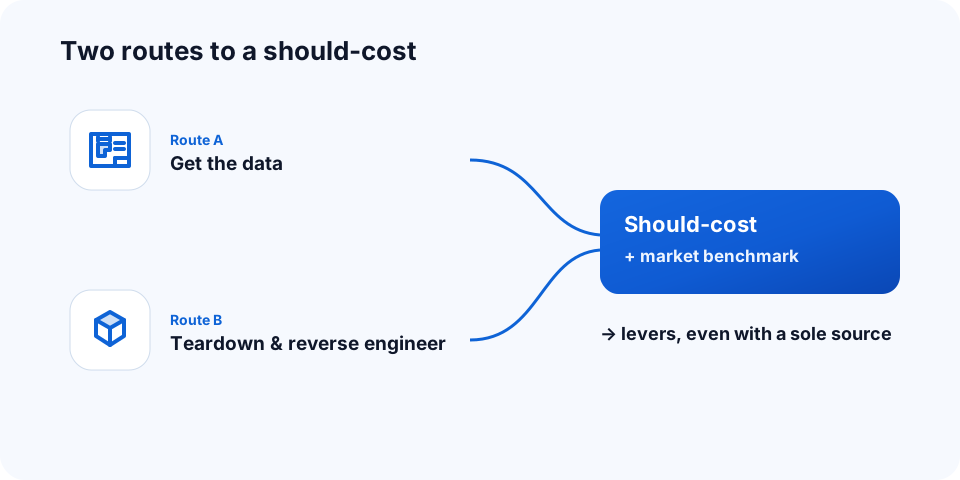
The two routes converge on the same should-cost.
- Route A: get the data. Ask the supplier for the 3D model and 2D drawing. Many will not share full design data for a proprietary part, but some will share enough for costing, especially in a long-term relationship.
- Route B: teardown and reverse engineering. Take the part apart, measure it, identify materials and processes, and build your own 3D model.
Cost it like any other part
Once you have a model, the part is costed from first principles: material from gross weight and grade, process from the route and cycle times, tooling, overheads, logistics and a fair margin.

Teardown measurements give the weights, features and finishes the cost model needs. Photo: Jessica Streser, Unsplash.
Add the market view
The engineering view says what the part should cost to make. A market benchmark adds what comparable parts are bought for, and where competitors source them. Together they show whether the price reflects cost, value or simply the lack of alternatives.
Using the result
With a should-cost and a benchmark, the conversation with a sole-source supplier changes from “can you do better?” to specific questions about material, process and margin. Use those levers respectfully: a sole-source relationship usually matters to both sides, and evidence-based discussions tend to preserve it.
A checklist for a proprietary part
- Confirm it is really sole-source. Sometimes a second source exists for the same function, even if not for the same part number.
- Ask for the data first (Route A). Explain that it supports a fact-based discussion.
- If not, plan the teardown (Route B): measure dimensions and weights, identify materials and finishes, and note each manufacturing process visible on the part.
- Build the 3D model from the teardown and cost it like any other part.
- Gather the market benchmark: comparable parts, where competitors source them and what they pay.
- Prepare levers and questions from the gap between price, should-cost and benchmark.
What teardown tells you beyond cost
A teardown also shows how the part is made: the process route, the number of operations, the materials and the finishes. That knowledge is valuable on its own, both for design-to-cost ideas and for qualifying an alternative source in future.

A full teardown shows how a product is built: part count, joining methods and materials. Photo: Shane Aldendorff, Unsplash.
Related reading
Grouping parts first helps decide which proprietary parts are worth the effort; see spend stratification. The method is part of the proprietary parts service.
Frequently asked questions
Will a supplier share data for a proprietary part?
Sometimes, especially for parts made to your requirements or when the relationship is long-term. If not, teardown is the alternative.
Is reverse engineering accurate enough for costing?
For costing, yes in most cases: weights, dimensions, materials and processes can be measured or identified from the physical part, which is what the cost depends on.
What is a market benchmark?
Evidence of where comparable parts are bought and at what price, from the market or competitors' products. It complements the engineering should-cost.
Keep reading
Procurement 3 min read Spend stratification: grouping parts into kitties
Split spend by product line, group parts into commodity kitties, should-cost each kitty and negotiate one supplier and one kitty at a time.Read the articleCosting 4 min read What is should-costing? A guide for procurement teams
Should-costing estimates what a part ought to cost from first principles. How it works, what it needs, and how buyers use it in negotiation.Read the articleNegotiation 3 min read Negotiating with a supplier using a cost breakdown
Compare the supplier's quote with a should-cost line by line, find where the gap sits, and turn each difference into a question the supplier can answer.Read the article