Negotiating with a supplier using a cost breakdown
Compare the supplier's quote with a should-cost line by line, find where the gap sits, and turn each difference into a question the supplier can answer.

Key takeaways
- Negotiate lines, not totals: a total invites a percentage haggle, a line invites an explanation.
- Gaps often concentrate in a few lines; find them before the meeting.
- Ask questions the supplier's engineers can answer with facts.
- Record what was agreed per line so the next review starts from evidence.
A negotiation over a total price has two moves: the buyer asks for less, the supplier gives a little. A negotiation over a cost breakdown has many more, and most of them are better for both sides.
Step 1: line up the two breakdowns
Put the supplier’s quote (or your reconstruction of it) next to your should-cost, using the same lines: material, process, tooling, overheads, packaging and freight, profit.
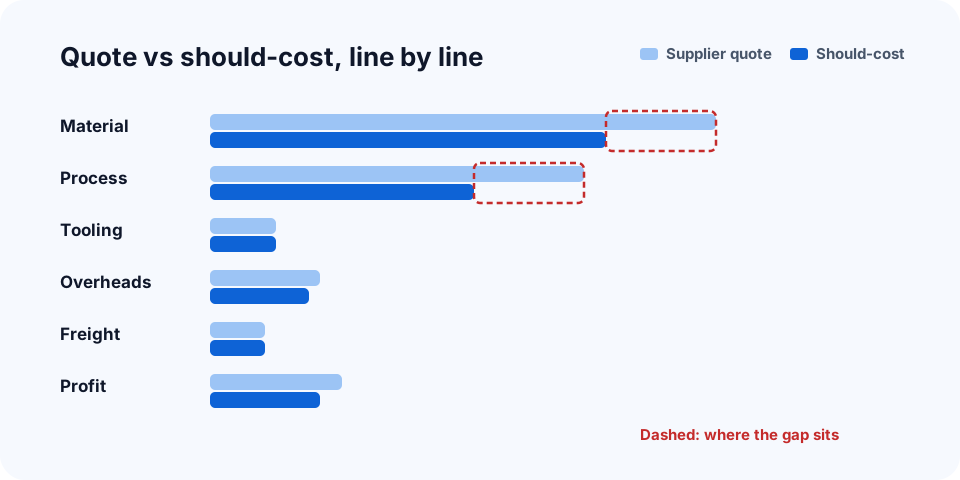
Illustrative comparison. In practice the gap often concentrates in a few lines.
Step 2: find where the gap actually is
Resist the urge to look at the total first. Look for the lines with the largest differences, then ask what assumption could explain each one:
- Material: a larger blank, a different grade, a higher scrap allowance, an older rate.
- Process: a slower cycle, an extra operation, a larger or older machine, a higher machine-hour rate.
- Tooling: amortised over fewer parts than your volume, or a more complex tool than needed.
- Overheads and margin: percentages above the norm for this supplier class.

Most of the gap usually sits in one or two lines: material weight or cycle time. Photo: Jakub Żerdzicki, Unsplash.
Step 3: turn differences into questions
The best questions are specific and answerable by an engineer:
- “Your blank is 1.1 kg; the part is 0.8 kg net. Which features need the extra stock?”
- “We have this at six minutes on a 3-axis VMC. Which operation takes the extra time on your route?”
- “Is the tooling amortised over the annual volume we quoted, or over a shorter period?”
Questions like these are hard to dismiss and easy to act on. A supplier who can explain a difference teaches you something; one who cannot will often correct it.
Step 4: agree line by line
Close each line before moving on, and write down what was agreed and why. The total follows from the lines. The record matters too: at the next price review, you start from an agreed cost model instead of starting over.

Agreement comes line by line, with the reason for each change written down. Photo: Mina Rad, Unsplash.
Common mistakes
- Leading with the total. It invites a percentage counter-offer and hides the evidence.
- Treating the should-cost as a demand. It is a benchmark. Some differences are legitimate.
- Skipping the engineers. Many gaps are process questions; bring someone who can discuss them.
Where to go next
Preparing the questions in advance is its own discipline; see preparing negotiation levers. To see the arithmetic behind a gap, try the quote-gap calculator.
Frequently asked questions
What if the supplier will not share a cost breakdown?
Your should-cost is still your breakdown. Present your assumptions and ask the supplier to show where they differ; many suppliers will respond to specific questions even if they will not open their books.
Should we show the supplier our should-cost?
Sharing the assumptions (weights, cycle times, process route) usually works better than sharing the total. It keeps the discussion on facts the supplier can confirm or correct.
What if the supplier's quote is below our should-cost?
Check the quote's assumptions. A quote well below an efficient cost can mean a different process, a missed requirement or a pricing risk that will return later as a claim.
Keep reading
Negotiation 3 min read Preparing negotiation levers before the supplier meeting
A negotiation lever is a specific, evidenced reason a price can move. How to find levers, rank them by evidence and impact, and prepare the questions.Read the articleCosting 4 min read What is should-costing? A guide for procurement teams
Should-costing estimates what a part ought to cost from first principles. How it works, what it needs, and how buyers use it in negotiation.Read the articleProcurement 3 min read Costing proprietary and sole-source parts
With no second quote, a should-cost is your only independent reference. Two routes to it, supplier data or teardown, plus a market benchmark.Read the article