Preparing negotiation levers before the supplier meeting
A negotiation lever is a specific, evidenced reason a price can move. How to find levers, rank them by evidence and impact, and prepare the questions.

Key takeaways
- A lever is specific, evidenced and owned by someone who can act on it.
- Rank levers by evidence first and value second: weak evidence wastes strong levers.
- Prepare the question, the evidence and the fallback for each lever.
- Separate levers the supplier controls from those you control, such as volume, specification or payment terms.
Good negotiators rarely improvise. They walk in knowing which few points they will press, how strong the evidence is for each, and what they will ask.
What makes a lever
A lever is not “your price is too high”. It is a specific reason the price can move, with evidence behind it:
- Specific: it names a line and an assumption (the blank weight, the cycle time, the overhead rate).
- Evidenced: it rests on a measurement, a simulation, a rate or a benchmark.
- Owned: someone on the supplier’s side can act on it.
Where levers come from
Compare the supplier’s quote with a should-cost line by line. Each significant difference is a candidate lever. Typical sources:
- Material: gross weight, grade, scrap allowance, material rate versus the index.
- Process: cycle time, number of operations, machine size, machine-hour rate.
- Tooling: amortisation period, number of cavities, tool life.
- Overheads and margin: percentages above the norm for the supplier class.
- Logistics: packaging, freight mode, pack quantities.

Levers come from the cost model, the market and your own volumes; engineering and finance both contribute. Photo: Sebastian Herrmann, Unsplash.
Rank them
Not every lever deserves meeting time. Plot them by two questions: how strong is the evidence? and how much could it save?
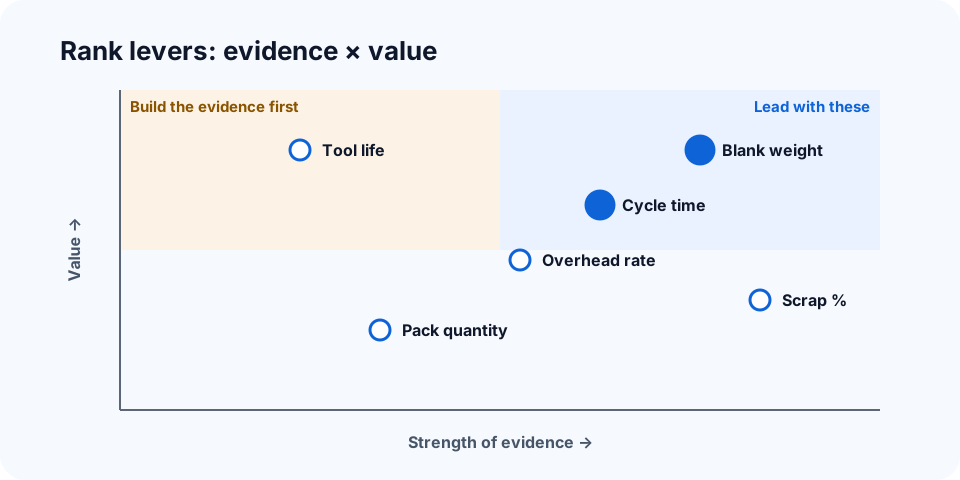
Illustrative lever chart. Lead with the top-right; fix the evidence on the top-left before using them.
- Strong evidence, high value: lead with these.
- Strong evidence, low value: quick agreements that build momentum.
- Weak evidence, high value: do more work first; a challenged lever loses credibility for the rest.
- Weak evidence, low value: drop them.
Prepare each lever
For every lever you will use, write down:
- The question, phrased so an engineer can answer it.
- The evidence, ready to show.
- The fallback, if the supplier explains the difference convincingly.
Remember the levers you hold
Some of the best levers are on your side of the table: a tolerance that can be relaxed, a material that can be substituted, a volume or contract length you can commit to. Offering one in exchange for a price correction often moves faster than pressing alone.

Volume, payment terms and a longer contract are levers on the buyer’s side. Photo: Radission US, Unsplash.
Related reading
Start from the comparison itself in negotiating with a cost breakdown, or see sourcing and negotiation on the services page.
Frequently asked questions
How many levers should we bring to a meeting?
Usually three to five. Lead with the best-evidenced lever, keep the rest ready, and avoid diluting a strong case with weak points.
What counts as evidence for a lever?
Measurable facts: net and gross weights, cycle times from a process simulation, published rates, a market benchmark, or the supplier's own earlier quotes.
Are all levers about the supplier's costs?
No. Some are yours: a relaxed tolerance, a material substitution, a higher order quantity or a longer contract can all reduce cost and are worth offering in exchange.
Keep reading
Negotiation 3 min read Negotiating with a supplier using a cost breakdown
Compare the supplier's quote with a should-cost line by line, find where the gap sits, and turn each difference into a question the supplier can answer.Read the articleSupply chain 3 min read Raw-material index pricing for part prices
How to link part prices to raw-material indexes: calculate material content per part, choose the index, set the review period, and adjust both ways.Read the articleCosting 4 min read What is should-costing? A guide for procurement teams
Should-costing estimates what a part ought to cost from first principles. How it works, what it needs, and how buyers use it in negotiation.Read the article