Raw-material index pricing for part prices
How to link part prices to raw-material indexes: calculate material content per part, choose the index, set the review period, and adjust both ways.

Key takeaways
- Only the material share of the price should move with the index.
- Material content per part (gross weight and grade) is the foundation.
- Agree the index, the base value, the review period and the lag in advance.
- Adjustments must work in both directions to be credible.
When commodity prices rise, suppliers write asking for an increase. When they fall, the letters are rarer. Index-linked pricing replaces that asymmetry with a formula both sides agreed in advance.
The principle
A part’s price has a material share and a conversion share. Only the material share follows commodity markets. Index pricing moves that share, and only that share, with a published index.
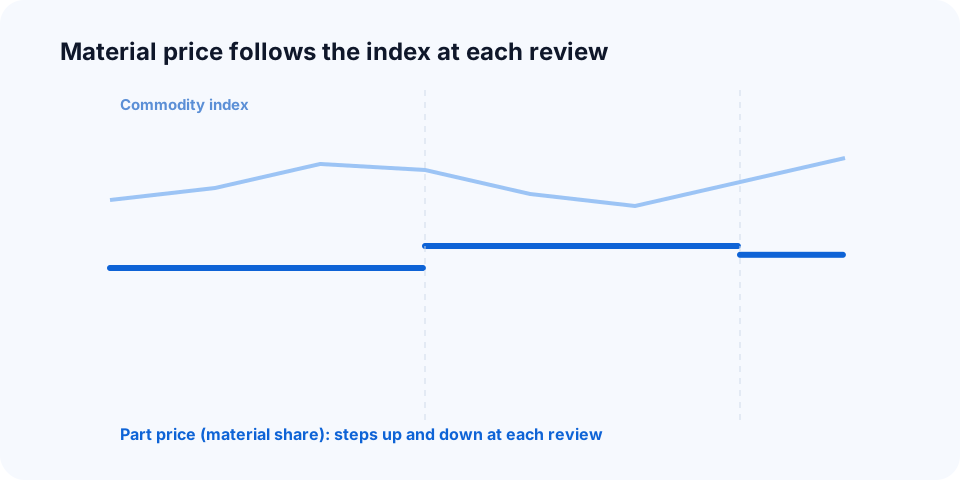
Illustrative. The material share of the price steps at agreed review periods, up and down, with the index.
What you need
- Material content per part. The gross weight consumed (net weight plus cutting loss, runners or scrap) and the grade. This is the foundation; if it is wrong, every adjustment is wrong.
- The index. Published regularly, independent, and representative of the grade and region you buy.
- A base value. The index value the current price was set against.
- A review period and lag. For example, quarterly, using the previous quarter’s average.
- A formula. Material adjustment = gross weight × (new − base material index) − recovered scrap weight × (new − base scrap index). Where the index is quoted in a different unit or form than the grade you buy, agree a fixed factor that converts it.

Each grade needs its own published index and a fixed gross weight per part. Photo: mastars MT, Unsplash.
Making it work in practice
- Calculate material content from the part, not from the invoice. A should-cost gives the gross weight directly from geometry and process.
- Keep the index and the grade matched. An index for one alloy applied to another introduces a permanent error.
- Publish the calculation. Each adjustment should be reproducible by both parties from public numbers.
- Apply it both ways. A clause that only moves up will not survive the first falling market.

Polymer granules follow their own indices; the clause should name the grade. Photo: Alexander Grey, Unsplash.
Beyond the clause
Index data is also a negotiation tool without a clause: tracking commodity movements across your part portfolio shows which suppliers’ price requests are justified, and comparing the material rates you pay with market and competitor rates exposes gaps.
A checklist for introducing index pricing
- Calculate gross material content per part from geometry and process, not from invoices.
- Choose an index per material and grade, published independently and accessible to both sides.
- Record the base index value that the current price corresponds to.
- Agree the review period and lag, for example quarterly using the previous quarter’s average.
- Write the formula into the contract and agree that it applies in both directions.
- Publish each adjustment with the index values used, so either side can reproduce it.
Related reading
See how the material line fits the whole cost in what is should-costing, or the raw-material negotiation service.
Frequently asked questions
Which index should we use?
One that tracks the grade and market you actually buy in, is published regularly by an independent source, and is accessible to both parties. Agree it in the contract.
Should conversion costs move with the index too?
No. Process, tooling and overheads do not follow commodity prices. Indexing the whole price over-adjusts in both directions.
How often should prices be adjusted?
Common practice is monthly or quarterly, with a lag so both sides can see the published values. Longer periods mean fewer adjustments but larger steps.
Keep reading
Costing 4 min read What is should-costing? A guide for procurement teams
Should-costing estimates what a part ought to cost from first principles. How it works, what it needs, and how buyers use it in negotiation.Read the articleSupply chain 3 min read Delivered cost: packaging, freight and duties
A part's real cost is what it costs at your dock. How packaging, freight, duties and tariffs fit into a should-cost and change sourcing decisions.Read the articleNegotiation 3 min read Preparing negotiation levers before the supplier meeting
A negotiation lever is a specific, evidenced reason a price can move. How to find levers, rank them by evidence and impact, and prepare the questions.Read the article